Zero to Agents
A free video course on AI agents is coming, and the first two episodes are done. Plus: personal agents from Meta, OpenAI and xAI, Washington's SI front door, Oracle's legal notice in Santa Teresa and the robot's final scorecard.
Howdy
Announcing Zero to Agents!
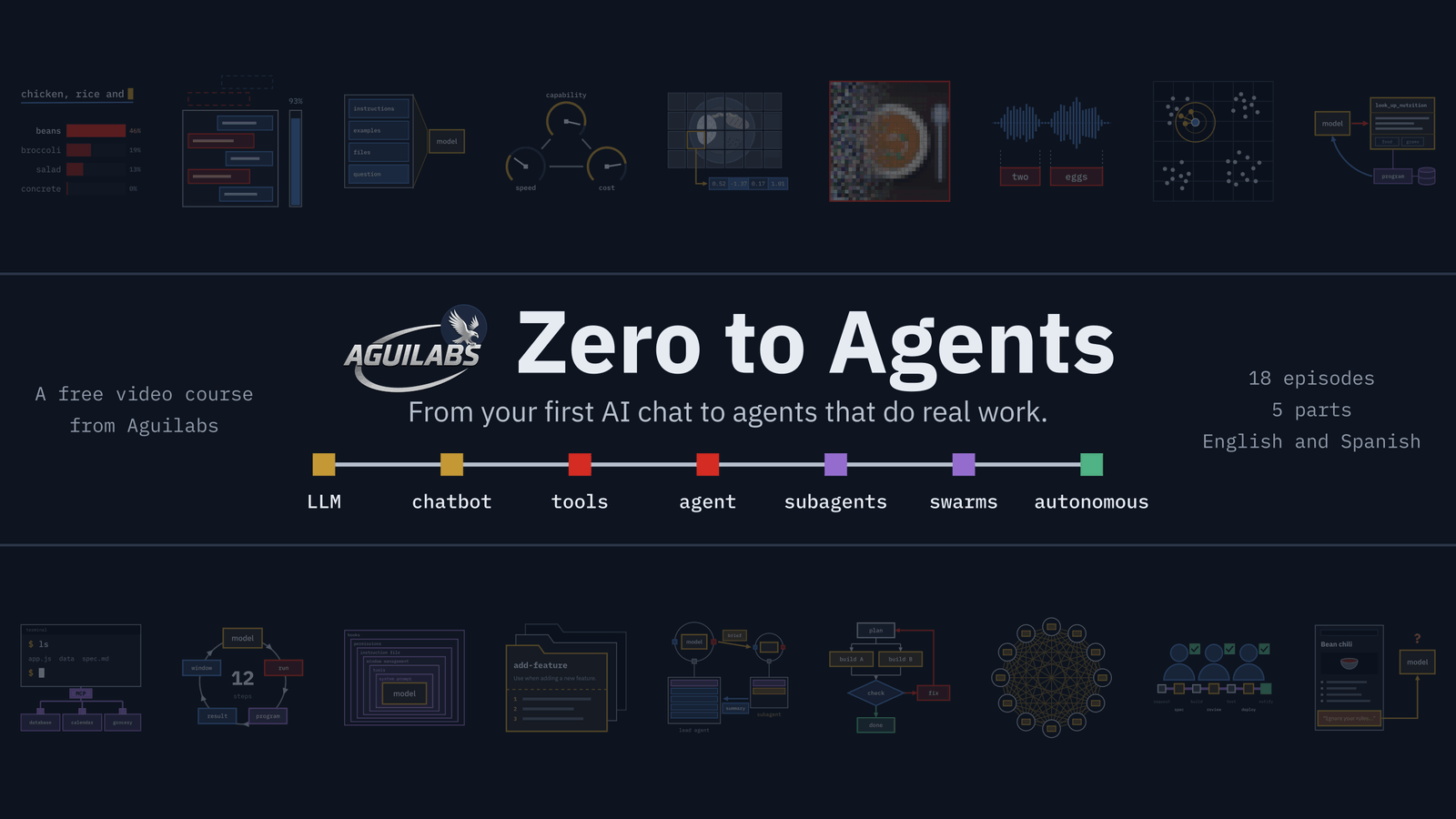
I use agents every day, and you keep hearing about them: this issue alone mentions three companies offering you a personal agent. So I'm making the from-zero explanation. Zero to Agents is a free video course in English and Spanish, animated and narrated by me, made for everyday people. No tech knowledge needed!
The promise is: "Go from your first AI conversation to practical agents that can help with real work and everyday tasks."
The plan is 18 episodes in five parts:
- The model. What a text model is and how to ask it for something useful.
- More than text. Models that see, speak, draw and search.
- Giving it tools. The model stops chatting about the work and starts doing it.
- Many agents. One agent becomes an organized team.
- Autonomy. From a request to building, testing, and shipping automatically.
Every episode works on one small app, a meal-prep tracker, and each hands more of the building to the machine. It starts with copying code out of a chat window. It ends with someone asking for a feature from their phone while the software builds, tests and ships it, with a person approving changes along the way.
Where it stands: in production. Episodes 1 and 2 are done, and coming this week. The episode list may change. Episodes will be announced to newsletter subscribers via email, and the course page is aguilabs.com/zero-to-agents.
Why you care: agents are arriving whether or not anybody explains them. I'd rather you know the capabilities and risks that come with autonomous AI agents.
Models: the gap keeps shrinking
Nine releases worth knowing about since the last issue, and four of them list at $2 in, $10 out. The newest is Anthropic's Claude Haiku 5.5, out October 7 from $0.10 in, $0.50 out. That fills in the 5.5 line with Opus, Sonnet and Haiku. Only Fable 5.5 is missing: the top model is still Fable 5.1, and Anthropic has not announced a 5.5.
| Model | Who | Date | Price per 1M tokens (in / out) | The pitch |
|---|---|---|---|---|
| Claude Haiku 5.5 | Anthropic | Oct 7 | From $0.10 / $0.50 | High-volume work, about 75 percent cheaper on average |
| Gemini 4 Argon | Sept 30, limited | $2 / $10 intro, then $4 / $20 | Not public yet | |
| GPT-6.1 Sol | OpenAI | Sept 29 | $2 / $10 | Matches Astra at coding |
| Claude Sonnet 5.5 | Anthropic | Sept 28 | $2 / $10 | Everyday work, more than 30 percent faster |
| Claude Opus 5.5 | Anthropic | Sept 22 | $4 / $20 | Fable 5.1's level "on most work" |
| GPT-6 Sol | OpenAI | Sept 22 | $2 / $10 | About half its predecessor's mistakes |
| GPT-6 Luna | OpenAI | Sept 22 | $0.10 / $0.50 | High-volume summarizing and extraction |
| Grok 4.7 | xAI | Sept 21 | $2 / $6 | Same price and speed as 4.6 |
| DeepSeek V4.1 Flash | DeepSeek | Sept 10 | $0.30 / $1.20 peak, half that off-peak | Open weights |
Opus 5.5 came in at $4 / $20, down from $5 / $25. OpenAI's and xAI's prices come from trade press, not their own pages. Argon is going first to what Google calls "trusted cyber defenders." Haiku 5.5's price is for prompts up to 100,000 tokens ($0.50 / $2.50 above that), down from $1 / $5 for Haiku 4.5.
The time between releases is shrinking fast.
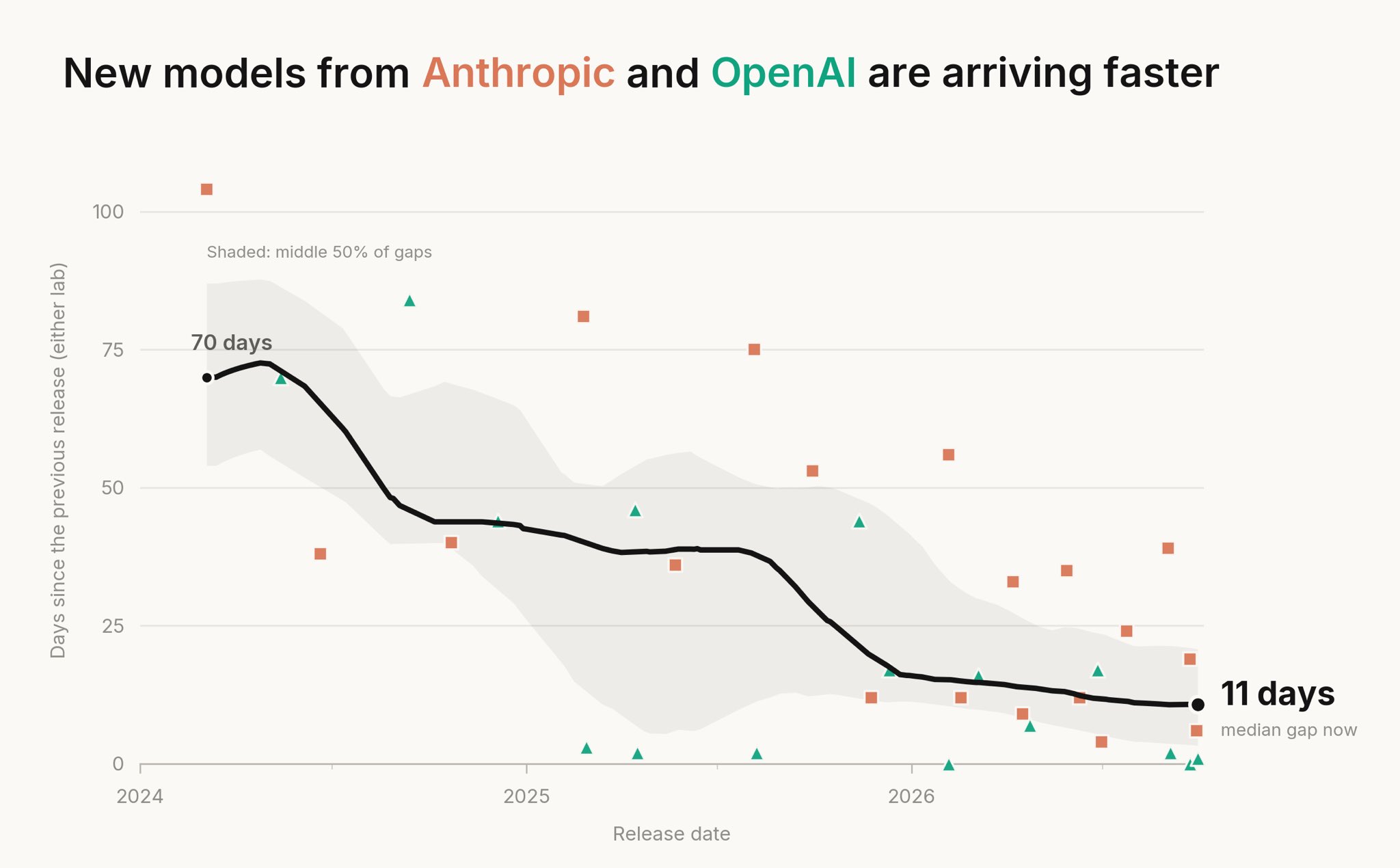
Credits to @jfonsecarivera on X who posted this chart on September 29. Each point is a new model from Anthropic or OpenAI, placed by the days since the previous release from either lab. We got a new model every 70 days or so in early 2024, that is down to every 11 days now.
A separate count of five US labs points the same direction: ARK Invest's analysis of Artificial Analysis data, reported in April, puts the median gap at 37.5 days in 2023, 13.5 in 2024, 17 in 2025 and 11 in early 2026.
So just how much intelligence does AI contribute?
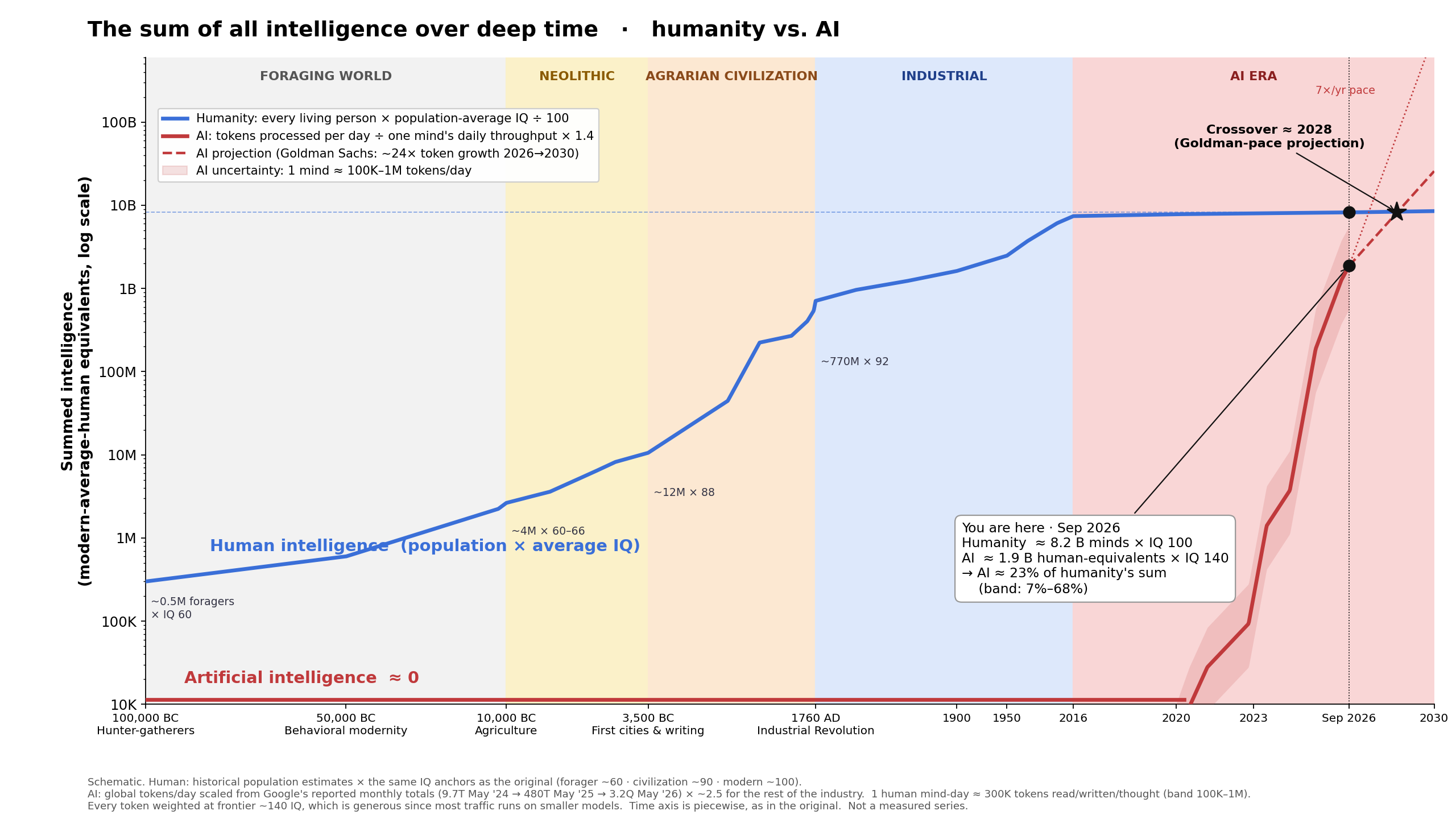
This one is a back-of-the-envelope estimate where I show cumulative IQ of all humanity vs AI IQ.
Blue is humanity: every living person times average IQ. Red is AI: the world's daily tokens (chunks of text) divided by what one human mind gets through in a day, all weighted at IQ 140. Its headline for September 2026: AI is about 23% of humanity's sum, with a band of 7% to 68%. At this rate AI will overtake the sum of human intelligence by 2028.
We are seeing it in math. If you saw headlines that AI solved a million-dollar math problem: on September 8 OpenAI released a computer-checked proof for one version of the Navier-Stokes problem, a famous open question about how fluids move. The Clay Mathematics Institute, which offers the prize, says the problem "has apparently been settled" and is under review.
On alignment. The rise in AI capabilities and intelligence does not mean you should be afraid. AI is not going to take over the world anytime soon. It is a tool that will help your business succeed if you know how to use it.
Why you care:
- Buy month to month. A tool you picked in spring is a few releases old by fall.
- Smarter models = business efficiency gains. Learn how to leverage AI capabilities to optimize and grow your business.
Personal agents are here: Muse, Bot, Dots
America.gov: Washington opens an SI front door
Back home: the blimp over Santa Teresa

I took this photo the evening of September 1, looking south toward the Santa Teresa crossing, and went looking for the news story behind it. There isn't one.
What I did find is that it's not new. Customs and Border Protection flies a surveillance balloon, called an aerostat, at the Santa Teresa Border Patrol Station, "just west of the Santa Teresa Port of Entry", right where my camera was pointing. The aerostat went up in September 2024 with daylight and infrared cameras, and in June 2025 KVIA reported no plans to remove it. If I have the right balloon, it has been up for about two years surveilling the border.
What is not public, in anything I could open: what it costs, how far its cameras see, who can pull the footage and how long it is kept.
Across the river, Torre Centinela opened September 9 in Juárez (Chihuahua state government) with US diplomats and Las Cruces officials in attendance. The state's numbers: a tower more than 115 meters tall, more than 7,700 cameras, 1,791 license-plate readers and anti-drone systems. La Verdad Juárez puts the platform at about 4.2 billion pesos over five years and the opening more than two years late.
Why you care:
- Last issue El Paso unplugged about 150 plate readers. Chihuahua just opened the command tower for a statewide network that it says includes 1,791. If your staff, trucks or customers cross, assume the trip is logged on at least one side.
- If your own shop runs cameras, Wi-Fi tracking or a plate reader, write down how long you keep the data and who can see it before a customer asks.
Project Jupiter: Oracle says "force majeure"
The robot's final scorecard
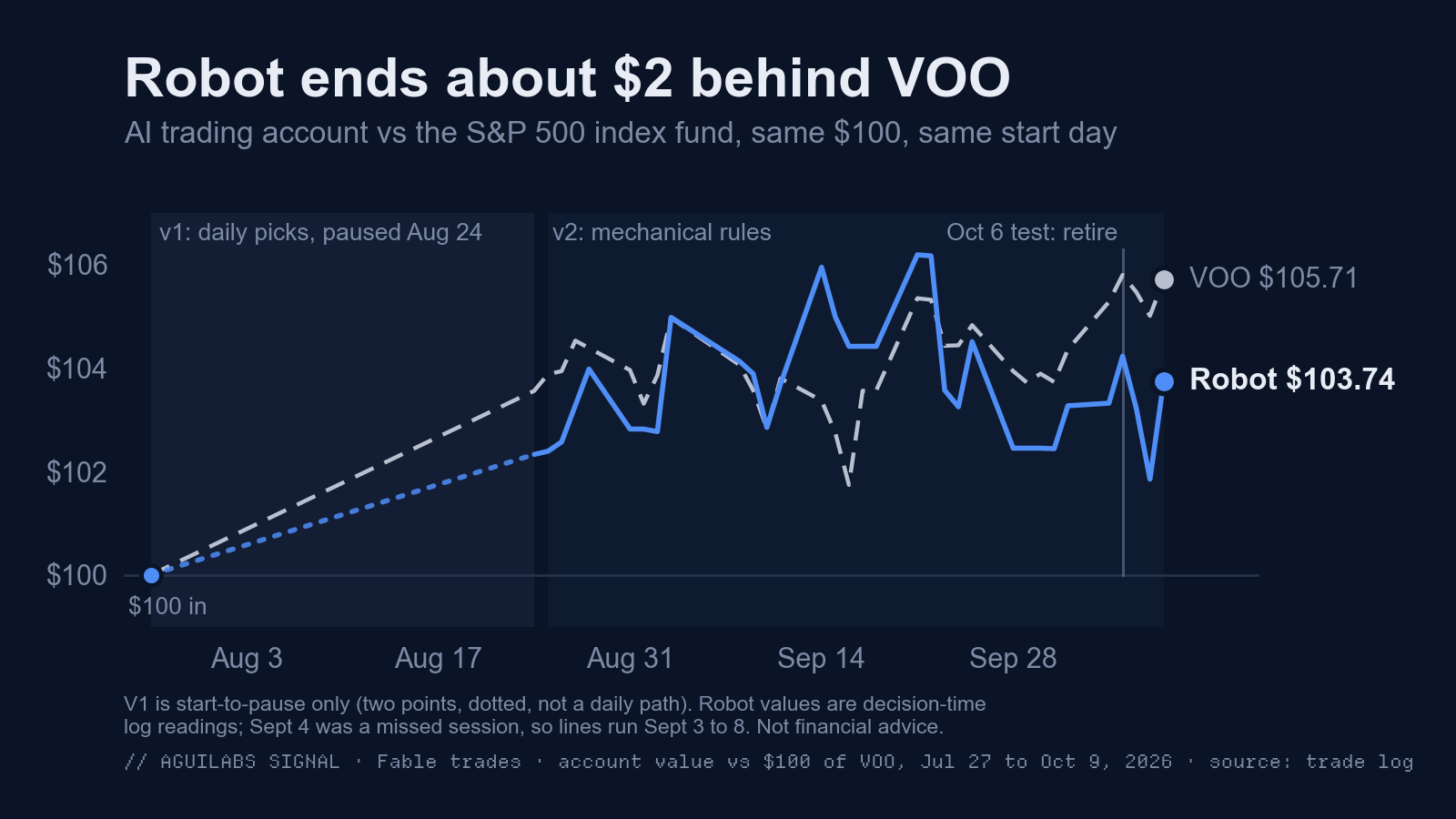
The robot lost to the S&P 500, and I'm shutting it down for now. At its last session, Friday, October 9, the account stood at about $103.74, against $105.71 for $100 of VOO bought the day this started, July 27. That is +3.7% for the robot and +5.7% for the S&P 500.
The test I wrote down in advance says the same. At session 30, on October 6, I checked whether the stocks the robot ranked highest went on to do better than the ones it ranked lowest. They did not: the relationship came out slightly negative, and the rule I set in August retires the signal "regardless of P/L."
What happens now: this version is done, pending a rewrite. Next I will redesign the trading strategy myself instead of letting an agent pick it. The agent will just run my strategy 24/7. The goal of beating the S&P 500 continues soon.
What I got wrong last issue. The table said September 4 through 8 was a "bot error" with no orders. Not right. September 4 was a missed run (the agent hit its AI model's usage limit), then came a weekend and Labor Day, and September 8 was a full session with five orders. It sold MU, NOW, JPM and TSLA, the four stocks I listed as "open," before that issue reached you. I also wrote "no orders" on a September 3 line that was itself an order. And the failures were in the scheduling and data plumbing, not the trading rules. My mistakes.
Closed trades since then, plus what was still open at the last session:
| Held | Position | Return | P/L |
|---|---|---|---|
| Sept 1 to 8 | MU | +7.30% | +$0.74 |
| Sept 1 to 8 | NOW | −6.83% | −$0.70 |
| Sept 1 to 8 | JPM | −0.53% | −$0.05 |
| Sept 1 to 8 | TSLA | +3.17% | +$0.32 |
| Sept 9 to 15 | SMCI | −7.81% | −$1.28 |
| Sept 11 to 14 | COIN | +10.35% | +$3.55 |
| Sept 22 to 28 | SPXL (3x S&P) | −3.56% | −$3.74 |
| Sept 8 to Oct 2 | VOO, four round trips (−$0.82, −$1.14, +$1.77, +$0.39) | n/a | +$0.20 |
| Oct 1 to 5 | AAPL | +1.18% | +$0.48 |
| Oct 5 to 9 | SPXL (3x S&P) | open | +$0.42 on paper |
| Sept 4, 17, 23 to 25, 29 to 30, Oct 7 to 9 | No orders | n/a | n/a |
Add up the closed trades and you get about fifty cents lost. COIN made $3.55 over a weekend. Then on September 22 the robot put the whole account into SPXL, the 3x S&P fund, and sold it on the 28th when its market gauge flipped to caution: down $3.74. It led VOO as late as September 22 and trailed at every daily check-in after that. On October 5 and 6 it went back into SPXL, which is what it held at its last session. It still broke, too: on September 17 it reached the order step 28 seconds past its own cutoff and skipped a buy.
Every order since September 8:
| Date | Order | Fill price | Closed P/L |
|---|---|---|---|
| Sept 8 | Sell MU, $10.93 | $999.37 | +$0.74 |
| Sept 8 | Sell NOW, $9.48 | $134.11 | −$0.70 |
| Sept 8 | Sell JPM, $10.13 | $353.76 | −$0.05 |
| Sept 8 | Sell TSLA, $10.50 | $367.57 | +$0.32 |
| Sept 8 | Buy VOO, $62.07 | $703.96 | n/a |
| Sept 9 | Buy SMCI, $16.42 | $38.91 | n/a |
| Sept 9 | Buy VOO, $24.62 | $701.33 | n/a |
| Sept 10 | Sell VOO, $85.87 | $696.59 | −$0.82 |
| Sept 11 | Buy COIN, $34.35 | $173.98 | n/a |
| Sept 11 | Buy VOO, $51.52 | $703.19 | n/a |
| Sept 14 | Sell COIN, $37.90 | $191.98 | +$3.55 |
| Sept 15 | Sell SMCI, $15.14 | $35.87 | −$1.28 |
| Sept 15 | Buy VOO, $37.90 | $695.61 | n/a |
| Sept 16 | Sell VOO, $88.28 | $691.03 | −$1.14 |
| Sept 18 | Buy VOO, $103.42 | $701.37 | n/a |
| Sept 21 | Sell VOO, $105.19 | $713.36 | +$1.77 |
| Sept 22 | Buy SPXL, $105.19 | $295.26 | n/a |
| Sept 28 | Sell SPXL, $101.45 | $284.76 | −$3.74 |
| Oct 1 | Buy AAPL, $40.58 | $329.93 | n/a |
| Oct 1 | Buy VOO, $60.87 | $702.72 | n/a |
| Oct 2 | Sell VOO, $61.26 | $707.19 | +$0.39 |
| Oct 5 | Sell AAPL, $41.06 | $333.82 | +$0.48 |
| Oct 5 | Buy SPXL, $61.26 | $295.63 | n/a |
| Oct 6 | Buy SPXL, $41.06 | $300.00 | n/a |
Orders from before September 8 are on issue #03's scoreboard.
Why you care: an agent left alone to design its own trading strategy is not smart enough to beat the S&P yet. I found the trading agent to simply be too conservative in general, which could be due to how Anthropic post-trains its models for safety. In your business, be careful with handing financial tasks to agents.
None of this is financial advice.