Small Touch, Big Signal
Juárez lands a $450 million AI server plant, frontier labs ship new models days apart, more World Cup controversy, and I hand an AI agent real money.
Howdy
Welcome back, Fable 5
Four labs, two weeks
Back home: Juárez will build the servers
The first two issues covered the data centers moving into our desert. Now the other end of that supply chain arrives.
On June 25, Taiwanese electronics giant Inventec announced a $450 million expansion of its Juárez plant to manufacture high-performance AI servers. The plan includes 45 new production lines, a 36,000-square-meter building acquired, another 43,000 square meters to be built, 30 hectares banked for growth, and more than 6,000 new jobs (Diario de Juárez).
The server racks that fill buildings like Meta's El Paso data center will get assembled a short drive from the bridge. Chips come in, servers go out, and the AI buildout now pays wages on both sides of the river.

Why you care
- Hiring at that scale affects the whole Borderplex labor pool, especially for technicians.
- Forty-five production lines will need local suppliers, logistics, and services. If you sell to maquilas, start reaching out now.
- More paychecks in Juárez means more customers in El Paso. The Borderplex works both ways.
More Borderplex briefs
Project Jupiter: tomorrow, July 21, is when New Mexico decides the air-quality permit for the $165 billion OpenAI and Oracle data center in Santa Teresa. Public pushback forced a hearing after 7,155 comments, four state senators rallied against the gas microgrid on July 2, and Oracle countered with a fuel-cell proposal to cut emissions and water use.
Safran: the company opened its fifth Chihuahua plant on July 1, a $7.4 million investment and around 800 jobs, running on 100% green energy (state release). The company now employs more than 10,500 people across the state.
World Cup tech
The robots called the final
Before the tournament, I had Claude research and fill out a full bracket. As the games went on I kept iterating and ran deep-research queries across more than 2,000 web sources throughout the tournament.
So how did it do?
| Stage | Outcomes correct | Exact scores | Grade |
|---|---|---|---|
| Group MD1 | 14/24 (58%) | 6 | C |
| Group MD2 | 17/24 (71%) | 4 | C+ |
| Group MD3 | 18/24 (75%) | 3 | B |
| Round of 32 | 13/16 (81%) | 2 | B+ |
| Round of 16 | 5/8 (63%) | 0 | C+ |
| Quarterfinals | 4/4 (100%) | 1 | A |
| Semifinals | 0/2 (0%) | 0 | F |
| Third place | 0/1 (0%) | 0 | F |
| Final | 1/1 (100%) | 1 | A |
| Group stage total | 49/72 (68%) | 13 | C+ |
| Knockout total | 23/32 (72%) | 4 | B |
| Final total | 72/104 (69%) | 17 | B- |
Honestly, a B- and 17 exact-score predictions is much better than I expected. The crazy upsets this World Cup were impossible to predict, so I won't be too critical. Overall I am impressed with the results.
I was not the only one who decided to test LLM predictions. ScoreGPT, which polls different models, had the consensus landing on Spain as champion before a ball was even kicked! Yesterday they were proven right, so expect a thousand articles on AI oracles now.
The research on LLM predictions is promising. A study in Science Advances found that a team of twelve models matched a crowd of 925 human forecasters. A newer paper tested frontier models on 464 real forecasting questions and found they beat the general crowd but not expert forecasters.
A chip in the ball, a call by a hair
Now the World Cup story everyone argued about. July 2, round of 32, Portugal against Croatia. Croatia equalized in stoppage time through Joško Gvardiol. The stadium went up, but then the goal was called off. What happened?
The Adidas Trionda match ball carries a motion sensor reading 500 times per second. It registered a touch no camera caught: the ball grazing the hair of Croatian forward Igor Matanović earlier in the move, which put a teammate offside. FIFA presented a heartbeat-style spike graphic as “proof.” Portugal won 2–1 and Croatia went home.
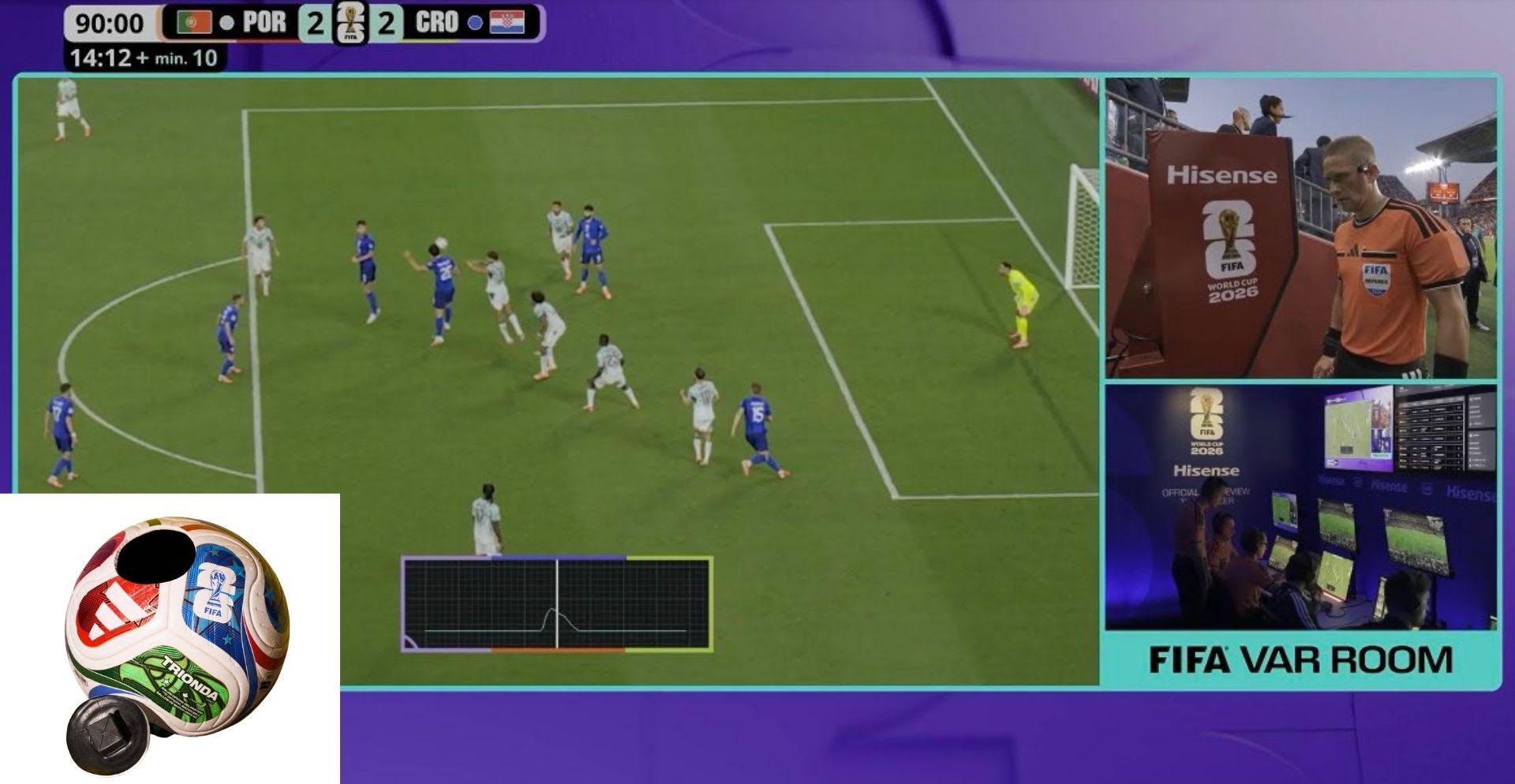
Matanović said afterward, “I felt a small contact with my hair”, and that the referee told him about the chip in the ball. Croatia filed a formal complaint accusing FIFA of “abuse of technology”, and their coach said the system goes against the spirit of the game.
I build data pipelines for a living and even I flinched at this one. The technology worked as designed, but that's the problem. When a machine can call offside by a strand of hair, the question becomes whether the rule was ever written for that level of precision.
Re-watch matches from inside them
On the friendlier end of World Cup tech, BBC Sport launched a 3D match experience that rebuilds games as navigable 3D scenes. Any camera angle you want, including through a player's eyes, live or on replay. It runs on the same FIFA skeletal-tracking data that powers the controversial offside system, built in collaboration with a startup called Immersiv.io.
UK only for now, which is a shame, but this is clearly where broadcasts are headed. The same data that ruined Croatia's night can rebuild the whole match like a video game.
AI meets the stock market
Last issue I promised we'd get into the agentic era of finance. I'm excited for this one.
In late May, Robinhood opened its platform to AI agents. The setup uses MCP, a popular protocol AI agents use to extend their toolkits. You create a separate agentic account, walled off from your main one, and your AI can read its portfolio, pull quotes, and place real stock trades. Options and crypto are coming soon too.
So I created a specialized finance agent and an agentic account. The model doing the trading is Fable 5. I funded the account with $100 to start, and I am fully prepared to lose it all.
The rules
- One check-in per day, after market close. Orders queue for the next open. No day trading, which also keeps the account clear of pattern day-trader rules.
- The stocks it can pick are S&P 500 stocks and the VOO index fund. Five positions max. No options and no margin.
- Fable writes a short thesis before every order. I record the log, wins and losses both.
- The benchmark is $100 of VOO bought the same day. Beat the index or admit it.
Now the disclaimers. Robinhood's own docs warn of “the possible loss of your entire investment”, and every trade the agent makes is legally mine. Nothing in this section is financial advice. This is an experiment with money I treat as already spent.
My expectations are low and I'm putting them in writing. As with the World Cup scores, research says AI models forecast about as well as a crowd of regular people and clearly worse than experts.
Portfolio updates next issue.